

The Osun State University Alumni Association led by Comr. AbdulBasit Olalekan Olokuta has perfected an art — the art of celebrating people in a bid to repackage and rebrand them. The latest examples out of several others are Dr. Raheem Oluwafunminiyi and Dr. Bibitayo Ayobami Owolabi, two academics whose citations were strenuously polished yet cast long shadows in the collective memory of the alumni community.
Both men are unquestionably educated. Both have academic credentials that are expected at a glance. But when the association praises them as “exemplary alumni,” it conveniently deletes the parts of their history that raise serious, unresolved questions.
Questions not invented by enemies.
Questions not whispered in corners.
Questions documented in the very reconciliation-platform chats the alumni leadership themselves participated in.
THE MONEY QUESTION NO ONE WANTS TO TALK ABOUT
One of the clearest examples appeared openly in the reconciliation chat:
₦1.3 million transferred to Owolabi Bibitayo’s personal account in 2018 without approval.
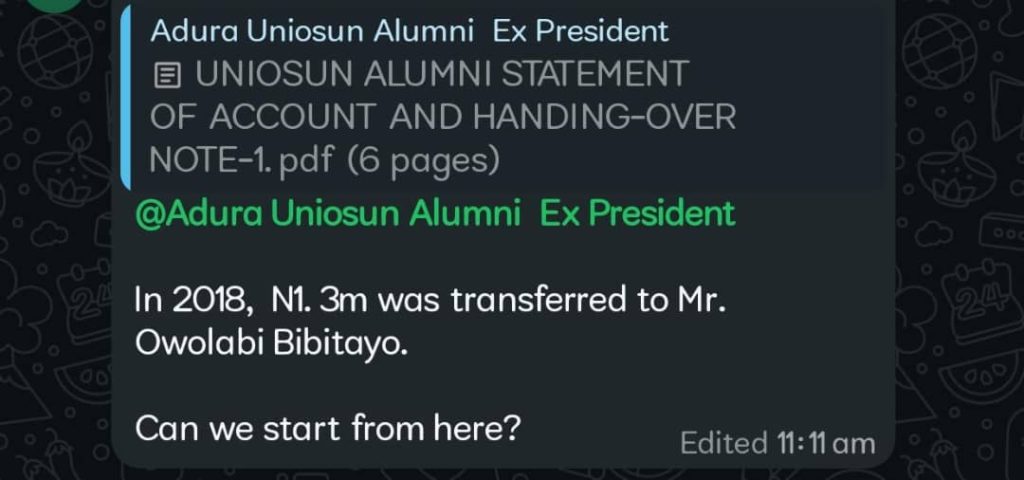
Members described it plainly —
“Money that was not approved.”
“Funds that should never have been in a personal account.”
This single incident sparked debates about financial misconduct and set in motion the mistrust that would later explode into a full-blown crisis.
Yet today, the Olokuta-led alumni association pretends this never happened.
No mention.
No accountability.
No explanation.
Instead, the same person linked to that period is now presented as a symbol of excellence.
THE ROLE THEY PLAYED IN THE CRISIS IS NOT A SECRET
These were not passive observers.Dr. Raheem Olufunminiyi on the other hand was fingered in tampering with the Constitution he was meant to review alongside a committee. As a member of NEC at the time (2018) he had faced checks and balances from the BOT in the budget requests he made for his office as PRO, and so he single-handedly inserted a clause in the constitution to give the NEC powers to remove the BOT. A chat reproduced below involving a member of the constitution review committee (CRC) Dr. Raheem led corroborates the events.
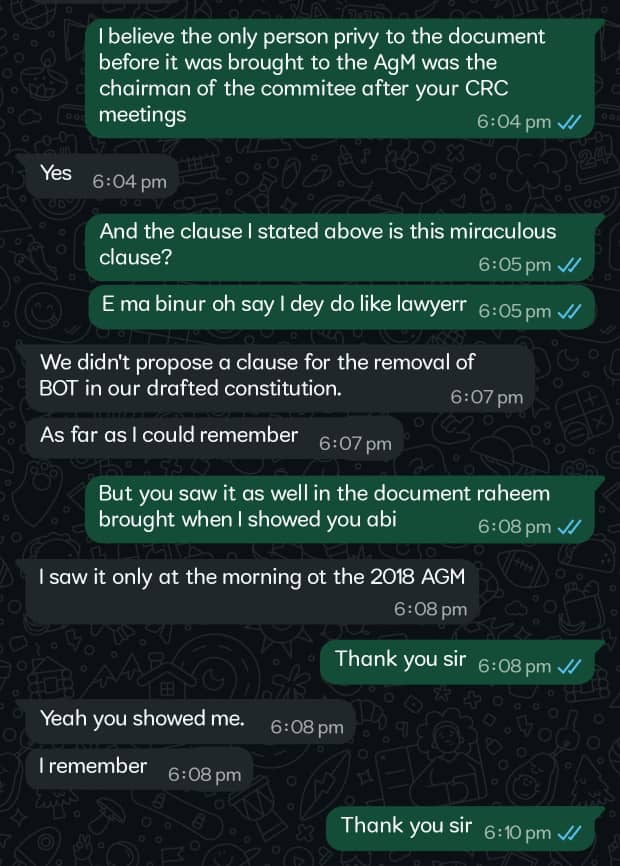
These actions not only shows the length he would go when desperate, it marks signs of dishonesty and someone not to be trusted with certain responsibilities. These were not innocent bystanders.
Their names show up in virtually every critical phase of the alumni conflict:
- caretaker leadership tussles
- factional alignments
- arguments over legitimacy
- disputes over financial transparency
- endless battles that dragged the alumni union into chaos
They were right there — in the thick of it — shaping narratives, influencing factions, and contributing to the tension that the association is still trying to recover from.
But in their celebratory profiles?
Silence.
Complete silence.
THE BIGGER QUESTION: IF INTEGRITY IS UNCLEAR IN ONE AREA, WHAT ABOUT OTHER AREAS?
Nigeria’s academic environment is not immune to internal politics. We all know this.
Whispers of:
- backroom deals
- covered-up misconduct
- quietly buried disciplinary cases
- preferential promotions
- committees that “manage” embarrassing issues
- networks that protect their own
- sex for grades scandals
…are part of the unfortunate reality of many tertiary institutions.
So when someone who had integrity questions in public service suddenly enjoys smooth, controversy-free academic progression, people naturally ask:
Did their academic rise happen in an environment where integrity is transparent — or in a system where things can be quietly arranged. A logical question.
Because if you can be linked to financial impropriety in one role, why should the public not wonder if the same behaviours or networks protected you in another?
SCHOLARSHIP WITHOUT INTEGRITY IS NOT EXCELLENCE — IT IS JUST PACKAGING
Academic achievement should rest on character, credibility, and ethics.
But the association now celebrates people as if:
- character doesn’t matter
- leadership history is irrelevant
- unresolved controversies are disposable
- the community has forgotten everything
This is not honour.
This is image laundering.
And it insults those who have served with transparency, humility, and genuine integrity.It also speaks of the kind of leadership being promoted by Comr. AbdulBasit Olalekan Olokuta, A NEC celebrating such characters as people of excellence or worthy of emulation is likely made up of individuals who need their images laundered as well.
THE ALUMNI ASSOCIATION CANNOT EDIT HISTORY BECAUSE OF POLITICS
By elevating individuals with well-documented controversies while refusing to acknowledge the past, the association endangers its own credibility.
It tells the world:
- integrity is optional
- memory is negotiable
- narrative is more important than truth.
But the history is being documented and will not be forgotten.
The documents exist.
The conversations are recorded.
The facts are not erasable.
THE FUTURE OF UNIOSUN ALUMNI DEPENDS ON HONESTY, NOT HYPOCRISY
If the alumni association truly wants to rebuild trust, it must stop acting like a PR agency and start acting like a responsible institution.
This means:
- acknowledging the full stories of those it celebrates
- demanding accountability from those with unresolved histories
- refusing to reward people whose actions once weakened the community
- restoring standards, not lowering them because someone was a sheep in your slaughter house.
Until then, every flyer, every award, and every glowing profile will ring hollow.
Because excellence without integrity is not excellence.
It is an illusion.